

TL;DR: Snowbird season doesn’t have to start with a two-day drive down I-95 or four checked bags at the counter. LuggageToShip, the AI-enabled TravelTech platform, compares DHL, FedEx, and UPS rates in real time, collects your belongings from your door, and delivers them to the winter home before you land — then stores eligible items up to six months complimentary when the season ends.
Table of Contents
Introduction
Ask a snowbird why they drive and the answer is almost never the scenery. It’s the stuff. The golf clubs, the second set of linens, the five months of clothing, the pickleball paddles, the box of kitchen things the condo never quite has. Somewhere along the way the car became a moving van, and the migration became a 1,400-mile, two-night, three-hotel-breakfast ordeal through whatever the Appalachians or the Plains decided to do with the weather that week.
The alternative used to be worse: fly, and surrender the luggage to the airline — four bags, two of them overweight, every fee charged again in April. So the drive won by default, year after year, for a generation of people who’d earned the right to never sit in traffic outside Richmond again.
Snowbird season 2026/27 has a third option, and it’s the one this guide is about. Send the belongings ahead. Fly with a carry-on. Let technology do the comparing, the booking, the tracking, and the storing. Here’s how the modern winter escape works when the suitcases travel separately.
The Three Ways South — Compared Honestly
Every snowbird migration comes down to one of three logistics models. Each has a true cost that rarely gets added up.
| Drive It Down | Fly + Check Bags | Fly + Send It Ahead | |
|---|---|---|---|
| Time | 2–3 days each way | Flight time + counter and carousel | Flight time, carry-on only |
| Out-of-pocket | Fuel, 2+ hotel nights, meals, vehicle wear — twice | Checked bag fee per bag per flight; overweight charges | One quoted rate per piece, round trip bookable |
| Capacity | Whatever fits in the car | Two bags per person, 50 lb each | Unlimited pieces; golf bags and boxes accepted |
| Weather and road risk | Real — winter storms on I-95, I-75, I-10 | None | None |
| Physical effort | Loading, unloading, hotel luggage carts | Hauling bags through two airports | A driver collects from your door |
| Return trip | The whole drive again in April | Fees again — heavier bags | Ship into storage; nothing travels north |
| Best for | Snowbirds who need the car down south | One light bag, direct flight | Seasonal relocation with real belongings |
The hidden baggage costs in the middle column are the ones the airline never totals for you: a second-bag fee that’s higher than the first, an overweight surcharge that often exceeds the bag fee itself, and all of it charged again on the way home. The hidden costs in the left column are time and risk — the kind that don’t show up on a receipt until something goes wrong in a snowstorm outside Nashville.
If you need your car in Florida or Arizona, there’s a well-established answer: an auto-transport carrier moves the vehicle while you fly. Pair that with sending the belongings ahead, and the drive disappears entirely.
Where Snowbirds Go — and What Goes With Them
Snowbird travel runs along a few well-worn corridors, and every snowbird season fills the same ones. The belongings differ by destination more than people expect.
| Destination | The Corridor | What Snowbirds Typically Ship |
|---|---|---|
| Florida (Gulf and Atlantic coasts) | Northeast, Midwest, Ontario, Quebec | Golf clubs, tennis gear, a full warm-season wardrobe, beach and pool items |
| Arizona (Phoenix, Scottsdale, Tucson) | Upper Midwest, Pacific Northwest, Alberta, BC | Golf clubs, hiking and cycling gear, layers for cool desert nights |
| Texas (Rio Grande Valley, Gulf Coast) | Plains states, Manitoba | Fishing gear, RV and outdoor equipment, warm-weather wardrobe |
| The Carolinas and Georgia coast | Northeast | Golf clubs, lighter layers — milder winters mean a two-climate wardrobe |
| Southern California and the Gulf Coast | Pacific Northwest, Mountain West | Cycling gear, beach items, casual wardrobe |
Whether you ship to Florida or ship to Arizona, the pieces are the same category: bulky, seasonal, and heavier than any airline’s limit was designed for. That’s precisely the category that benefits most from going ahead on its own.
How the Modern Migration Works
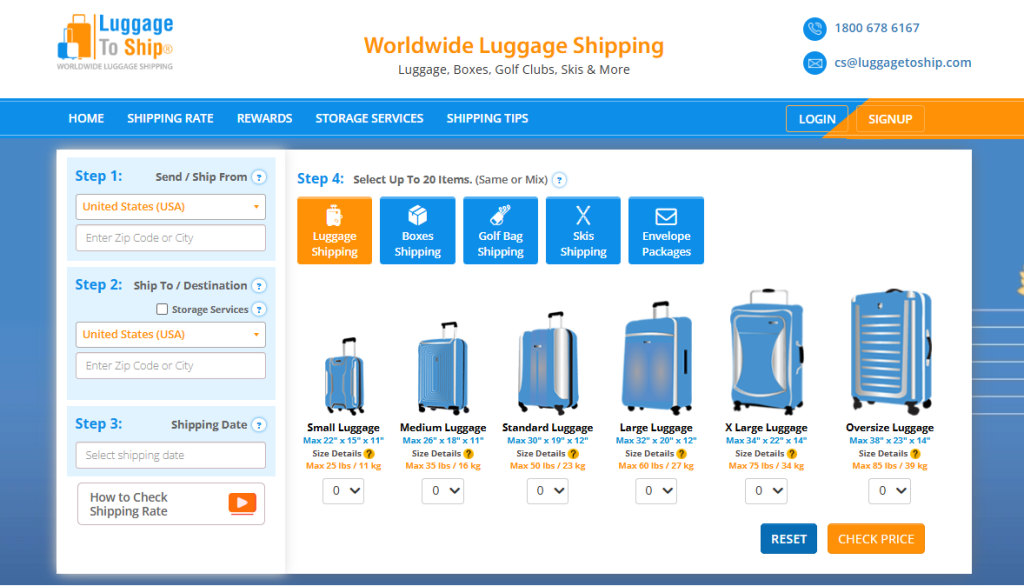
LuggageToShip is a technology marketplace, not a carrier — it doesn’t operate trucks or aircraft. What it does is put DHL, FedEx, and UPS side by side, apply an AI rate engine to the route and the pieces, and let you book the whole season in one sitting. That’s the “TravelTech” part, and for snowbird season it’s the difference between a migration you plan and one you endure.
Step 1: Compare and Book — Months Ahead if You Like. Enter your northern address, the winter-home address, and each piece — suitcases, boxes, the golf bag — at luggagetoship.com. The platform returns live DHL, FedEx, and UPS rates for the route in seconds, with express and economy options. Book now, ship later: set the pickup date for the week before you fly, and book the April return at the same time if you already know it.
Step 2: Labels and Customs, Generated for You. Digital labels arrive by email the moment you book; customs documents are produced automatically for cross-border routes — relevant for the Ontario-to-Florida and BC-to-Arizona corridors. Print, attach, done.
Step 3: Pickup From Your Door. A FedEx or DHL driver collects everything on the scheduled date. No lifting a golf bag into a trunk, no trip to a counter. Drop-off at any of 25,000+ FedEx and DHL locations is available if that’s more convenient.
Step 4: Tracked to the Winter Home. Real-time tracking by email and SMS from pickup to the condo door or the building office. Your season is unpacked before you’ve returned the rental car.
Step 5: Season Ends — Store, Don’t Haul. In April, book a pickup from the winter home and send the belongings into storage instead of north. Eligible items are stored up to six months complimentary, subject to terms — which lines up neatly with the gap between one snowbird season and the next. Next November, they ship from storage straight back to the winter home.
Why Snowbirds Are Choosing the TravelTech Route
The appeal isn’t only the convenience. It’s that the technology removes the specific pain points of a seasonal relocation one at a time.
- The comparison is done for you. Three carriers, one screen. The AI rate engine weighs route, weight, and dimensions and surfaces the best-priced option — typically up to 70% below retail counter rates.
- The weight cliff disappears. A 58-pound suitcase is quoted, not penalized. There’s no 50-pound line to pack around.
- The round trip is one booking. Future pickup dates and return legs are set in advance, so April is already handled in November.
- Nothing irreplaceable leaves your side. Medications, documents, and electronics stay in the carry-on; everything bulky travels on its own tracked journey.
- Support is human and around the clock. 24/7 by phone — not an app to learn, not a chatbot to argue with.
- Insurance is included. Default coverage on every piece, with optional higher coverage for the clubs you actually care about.
That combination is why LuggageToShip was named a 2026 Inc. Power Partner Award winner in the AI, Technology & Development category, why it serves more than 100,000 customers, and why it holds a 4.7 out of 5 on Trustpilot from thousands of reviews — company-reported figures, but the kind that accumulate only when the platform works for people who use it twice a year, every year.
Snowbird Packing When the Suitcases Go Ahead
Snowbird packing changes shape once the belongings travel separately. The question is no longer “what fits in two bags” but “what flies with me and what goes ahead.”
Goes ahead, a week before you fly:
- The full season wardrobe — both the cool early weeks and the warm late ones
- Golf clubs, tennis and pickleball gear, cycling equipment, fishing tackle
- Extra shoes, linens, towels, and the kitchen items you’re particular about
- Books, hobby supplies, gifts for the grandchildren’s visit
- Anything heavier than you’d want to carry through an airport
Flies with you, in the carry-on:
- Passport, ID, insurance cards, a printed tracking number
- A full month of medications in original containers
- Phone, tablet, chargers, hearing-aid batteries, reading glasses
- One week of clothing for the destination’s current weather
- A light layer for the plane and the first cool evening
For the week-by-week version — house prep, mail, insurance, keys — our snowbird checklist covers the full countdown from six weeks out.
A Note for Canadian Snowbirds
The Ontario-to-Florida and British Columbia-to-Arizona corridors add a border to the migration. Used personal belongings sent for your own use are treated as personal effects and generally move without duty when declared accurately with realistic used values. The platform generates the customs documentation at booking, so the paperwork isn’t yours to figure out. Keep medications in the carry-on in original packaging, confirm your provincial health plan’s rules on time outside the country, and carry proof of travel insurance. Sending belongings ahead rather than checking them also sidesteps transborder baggage fees, which run higher than domestic ones on most carriers. The Canada Border Services Agency publishes guidance on what to declare when returning north at the end of snowbird season.
Conclusion
Snowbird season used to force a choice between two bad options: drive the belongings down and lose three days each way, or fly and pay the airline for every bag, every pound over, every direction. The TravelTech route removes the choice. Compare DHL, FedEx, and UPS in one place, book the pickup for the week before you fly, land with a carry-on, and find the season already waiting. In April, send it into storage and let next November start with a single click instead of a loaded car.
LuggageToShip is built for exactly this migration — 220+ countries, three carriers compared in real time, door pickup, tracked delivery, and complimentary storage on eligible items between seasons. Run the route through the cost calculator, set it against the drive and the bag fees, and give the car — and your back — the winter off.
Frequently Asked Questions
What is snowbird season?
Snowbird season is the annual migration of people — mostly retirees from the northern US and Canada — to warmer southern states such as Florida, Arizona, and Texas for the winter, typically from November through April.
How do snowbirds get their belongings south without driving?
By sending them ahead. LuggageToShip collects suitcases, boxes, and golf bags from the northern home, compares DHL, FedEx, and UPS rates, and delivers to the winter address before arrival — so only a carry-on flies.
Is it cheaper to ship belongings south or drive them?
For most snowbirds, yes. Driving costs fuel, two or more hotel nights, meals, and vehicle wear in each direction; flying with checked bags stacks per-bag and overweight fees both ways. One quoted rate per piece, with door pickup included, is usually lower once everything is counted.
How much is a checked bag fee for a snowbird trip?
It varies by airline, but a snowbird season’s worth of belongings typically means three or more bags with at least one overweight, charged in both directions. Our guide to the real cost of a checked bag adds up every line.
Can I ship golf clubs to Florida or Arizona?
Yes. A golf bag in a travel cover is collected from your door and delivered to the condo, club, or pro shop as a standard piece — without airline special-item fees.
How far in advance should snowbirds book?
Book pickup for about a week before departure on economy service. LuggageToShip supports advance booking, so you can set the November pickup — and the April return — months ahead. Add buffer days around Thanksgiving and the December holidays.
