

TL;DR A good snowbird checklist covers the house you’re leaving, the paperwork that follows you, and the months of clothing and gear that won’t fit in two checked bags. Ship the wardrobe and the golf clubs ahead with LuggageToShip through FedEx, DHL, or UPS — then store them free for the off-season instead of hauling everything north again in April.
Introduction
There’s a particular kind of packing problem that only snowbirds know. It isn’t a trip. It’s a season — four, five, sometimes six months in a second home, with a wardrobe that has to cover a Florida January and a Florida April, the golf clubs, the tennis racquets, the pickleball paddles, the good walking shoes, the reading pile, and the small comforts that make a condo feel like yours. None of that fits inside the airline’s two-bag, fifty-pound arithmetic. Every year, somewhere in a northern driveway in November, someone is standing over three open suitcases trying to make it fit anyway.
This snowbird checklist is built around a simpler idea: stop trying. Pack a carry-on for the flight. Ship everything else to the door of the winter home a week before you leave, and let it be waiting when you arrive. Then, when the season ends, ship it into storage rather than back up north. The checklist below walks through the whole migration — home, paperwork, wardrobe, gear, and the return — with the shipping steps built in where they belong.
The Snowbird Checklist at a Glance
Work backward from your departure date. Most of the items are small; the point of the list is that none of them get forgotten in the last week.
| Timing | Task | Notes |
|---|---|---|
| 6–8 weeks out | Confirm winter-home arrival date and address | Shipping and mail forwarding both key off this |
| 6 weeks out | Book a cleaning or check-in service for the winter home | Have the place ready to receive packages |
| 4–6 weeks out | Review health insurance coverage for the destination state or country | Especially for Canadian snowbirds crossing into the US |
| 4 weeks out | Sort the wardrobe: carry, ship, or leave | See the sorting table below |
| 3 weeks out | Set up USPS Hold Mail or forwarding | Or a trusted neighbor with a key |
| 2–3 weeks out | Book the luggage shipment for the week before departure | Door pickup; delivered before you land |
| 2 weeks out | Arrange northern-home winterization — thermostat, water, lawn, security | Confirm who holds the keys |
| 1 week out | Shipment picked up from your door | Carry-on only from here |
| Departure week | Pharmacy refills, documents, electronics into the carry-on | Nothing irreplaceable ships |
| Arrival | Collect shipment from the building office or doorstep | Unpack into a closet, not a suitcase |
The Wardrobe Problem Nobody Solves With Suitcases
A season’s clothing isn’t a week’s clothing multiplied. It’s two climates — cool, damp early-winter weeks and warm late-season ones — plus outfits for the golf course, the club, the beach, the restaurant, the grandkids’ visit, and whatever the social calendar produces over five months. Honest snowbirds pack for all of it, which is exactly why the checked bag fee conversation gets uncomfortable fast.
Here’s the carry-on vs checked reality for a season-long stay: the carry-on holds a week. One checked bag holds perhaps three. The third and fourth bags each carry their own fee, and at least one of them is over fifty pounds, which triggers an overweight charge that often costs more than the bag fee itself. Then the whole exercise repeats in April, with the bags now holding whatever was bought over the winter.
The alternative is to treat the wardrobe as cargo rather than luggage. Fold it into a large suitcase or a couple of boxes, label them, and have them collected from your door. Weight is priced rather than penalized. There’s no second-bag fee, no overweight cliff, and the clothes arrive at the winter home before you do. For a full accounting of what checking bags really costs over a round trip, our guide to the real cost of a checked bag adds up every line.
What to Carry, What to Ship, What to Leave
This is the heart of the snowbird checklist. Sort every item into one of three columns before a single bag is packed.
| Carry With You | Ship Ahead | Leave at the Northern Home |
|---|---|---|
| Passport, ID, insurance cards | Season wardrobe — both climates | Heavy winter coats and boots (you’re leaving winter) |
| Prescriptions and a full first month’s supply | Golf clubs, tennis and pickleball gear | Furniture-scale items the winter home already has |
| Laptop, tablet, phone, chargers | Walking and golf shoes beyond the pair you’re wearing | Anything the winter home has a duplicate of |
| One week of clothing | Books, hobby supplies, craft materials | Formal wear you won’t need |
| Jewelry and anything irreplaceable | Bedding or towels if the winter home lacks them | Spare electronics |
| Reading glasses, hearing-aid supplies, medical devices | Small kitchen items you’re particular about | Holiday decorations — unless the season includes the holidays |
| A light layer for the plane | Gifts for the grandchildren’s visit | The second car’s worth of things that “might be useful” |
The rule for the middle column: if it’s bulky, heavy, or there’s more than one of it, it ships. The rule for the first column: if losing it would end the trip, it flies with you.
Golf Clubs and Sports Gear: Always Ship
Sports equipment is where airlines are least kind. A golf bag is a special-item tier on most carriers, with its own fee structure and its own handling risks. Tennis and pickleball gear takes up a bag that could have held clothes. Bikes are a separate problem entirely.
Shipping treats all of it as a standard piece. A golf bag in a travel cover, collected from your door, delivered to the pro shop or the condo — and, at the end of the season, collected again and shipped into storage until next November. No airline special-item fee, no watching the bag come down the oversize chute.
How the Shipping Works
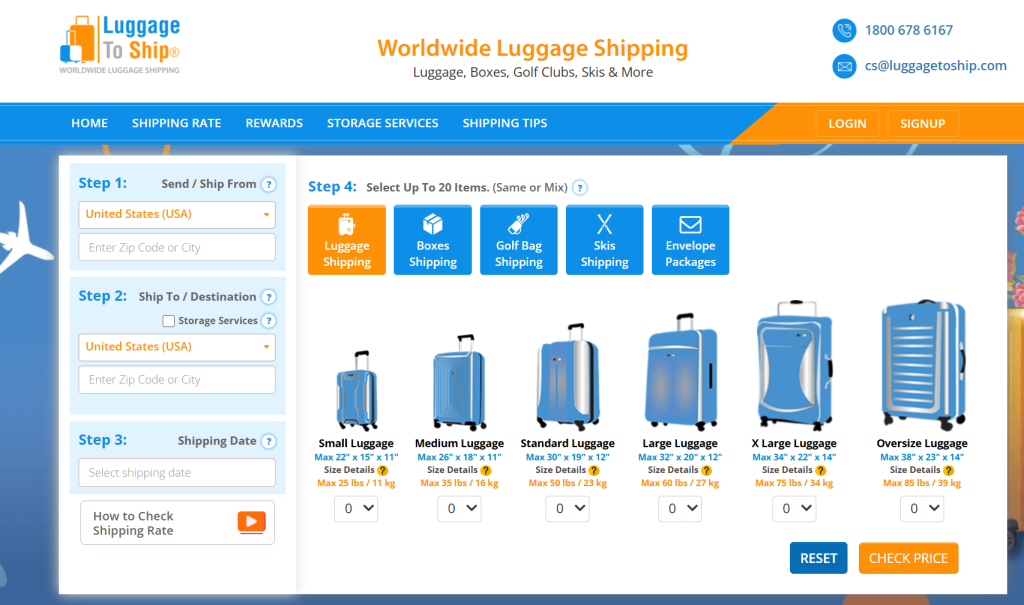
LuggageToShip ships across all 50 states and to 220+ countries, which covers the whole snowbird map — the northern US and Canada to Florida, Arizona, Texas, the Carolinas, and the Gulf Coast.
Step 1: Book Online or Call Us. Enter your home address, the winter-home address, and each piece — suitcases, boxes, golf bag — with approximate weight at luggagetoship.com. The cost calculator shows FedEx, UPS, and DHL rates side by side. Prefer to talk it through? An agent handles the whole booking by phone.
Step 2: Receive Your Shipping Labels. They arrive by email — or by mail, if you prefer paper. One label per piece, attached flat and taped over.
Step 3: Pickup From Your Door. A FedEx or DHL driver collects everything on the scheduled date. No carrying bags to a store, no lifting a golf bag into a car. Drop-off at any of 25,000+ locations is available too, if that’s easier.
Step 4: Delivered to the Winter Home. Tracked door-to-door by email and SMS. Let the building office or a neighbor know the delivery window, and your season is unpacked before you’ve finished the drive from the airport.
Why it suits snowbirds in particular:
- Partners with FedEx, DHL, and UPS, choosing the best-priced carrier for the route
- Savings of up to 70% off retail carrier rates
- No weight cliff — a 60 lb suitcase is simply priced, not penalized
- Default insurance included, with optional higher coverage for the good clubs
- 24/7 human support by phone — not an app you have to learn
- Six months of free storage — the piece of this that changes the whole migration
The Off-Season Trick: Store It, Don’t Haul It Back
Snowbird season runs roughly November to April. LuggageToShip’s free storage runs six months. Those two numbers line up almost perfectly.
At the end of the season, rather than shipping the wardrobe and the golf clubs back north — where they’ll sit in a closet until next November — ship them into LuggageToShip’s storage. They’re held free for six months, then just $10 per item per month if the summer runs long. Next autumn, they ship straight from storage to the winter home again. The southern wardrobe never has to see a northern closet, and the fall migration starts with a single booking instead of a weekend of packing.
For Canadian snowbirds, this has a second benefit: fewer belongings crossing the border twice a year means less to declare each way.
A Note for Canadian Snowbirds
The cross-border version of the snowbird checklist has a few extra lines. Used personal belongings shipped for your own use are treated as personal effects and generally move without duty, but declare contents accurately with realistic used values. Confirm your provincial health plan’s rules on time outside the country, and carry proof of travel insurance. Medications travel with you, in original packaging, with a supply that covers the stay. And shipping, rather than checking, sidesteps the airline fees 2026 brought to transborder routes, where second-bag and overweight charges run higher than on domestic flights.
The Carry-On That Flies With You
With the season shipped ahead, what boards the plane is small and deliberate:
- Documents, insurance cards, and a printed copy of the shipping tracking number
- Medications for the full first month, in original containers
- Phone, tablet, chargers, hearing-aid batteries, reading glasses
- One week of clothes for the destination’s current weather
- A sweater for the plane and the first cool evening
- Anything that would end the trip if it were lost
That’s a bag that fits in the overhead bin and takes ninety seconds to clear the carousel it never visits.
Conclusion
The snowbird checklist that works isn’t the longest one — it’s the one that stops treating a five-month season like a two-week holiday. Prepare the house, set up the mail, sort the wardrobe into carry, ship, and leave, and get the heavy middle column out of the airport entirely. Ship it to the winter home a week before you fly. Store it free when the season ends. Ship it back down next November with a single booking.
LuggageToShip handles the pickup from your door, the FedEx, DHL, and UPS transit, the delivery to the winter home, and the storage in between — at up to 70% off retail rates. Run your route through the cost calculator, compare it against four checked bags each way, and give the suitcases the winter off.
Frequently Asked Questions
What should be on a snowbird checklist?
Home preparation (winterizing, mail, keys), paperwork (insurance, prescriptions, documents), the wardrobe sorted into carry, ship, and leave, sports gear shipped ahead, and the return-trip plan — including off-season storage so the southern belongings don’t travel north.
How do snowbirds get their belongings to the winter home?
The simplest method is shipping: suitcases, boxes, and golf bags are collected from the northern home by a FedEx or DHL driver and delivered to the winter address before arrival, so only a carry-on flies.
Is shipping luggage cheaper than checking bags for a snowbird season?
For a season’s worth of clothing plus sports gear — typically three or more bags, at least one overweight — shipping is usually cheaper once second-bag and overweight fees are counted on both the outbound and return trips. Run the cost calculator for your route to compare.
What should snowbirds carry on the plane instead of shipping?
Documents, insurance cards, a full month of medications, electronics, jewelry, medical devices, and one week of clothing. Anything irreplaceable flies with you; everything bulky ships.
Can I ship golf clubs to my winter home?
Yes. A golf bag in a travel cover ships as a standard piece, collected from your door and delivered to the condo or pro shop — without airline special-item fees.
How early should snowbirds ship their belongings?
Book pickup for about a week before departure for standard ground service, so everything is delivered before you arrive. Add a few days around Thanksgiving and the December holidays when carrier volume peaks.
Can snowbirds store belongings between seasons?
Yes. Every LuggageToShip shipment includes six months of free storage — enough to cover the summer. Ship the southern wardrobe and gear into storage in April and have it delivered back to the winter home the following November.
What carriers does LuggageToShip use for snowbird shipments?
LuggageToShip partners with FedEx, DHL, and UPS and selects the best-priced carrier for each route, with pickup, insurance, and tracking included.
Can Canadian snowbirds ship belongings to the United States?
Yes. LuggageToShip ships cross-border with customs documentation generated at booking. Declare used personal effects accurately, keep medications in your carry-on, and confirm your provincial health coverage rules for time abroad.
Will my condo or community accept a shipped delivery before I arrive?
Most do. Confirm with the building office or management company, provide the delivery window, and have a neighbor or the office hold the pieces if you’re arriving later in the day.
What happens if my shipped bag is heavier than expected?
Weight is priced rather than penalized, so a heavier piece simply quotes higher — there’s no airline-style overweight cliff. Give an honest estimate at booking to avoid an adjustment at pickup.
Can I track my belongings while they ship?
Yes. Every shipment includes real-time tracking by email, SMS, and an online dashboard, using the carrier’s own tracking number.
