

TL;DR: The cheapest way to ship boxes overseas for a small move is per-box courier shipping, not a freight container: a driver collects from your door, and your boxes arrive in days, not weeks. LuggageToShip ships through FedEx, DHL, and UPS to 220+ countries at up to 70% off retail rates, with customs paperwork, tracking, and insurance included.
Introduction
Search for how to ship boxes overseas and most of what you’ll find is written for a different person than you. Container quotes. Pallets. Freight forwarders. Port fees. Marine insurance. That world exists for families relocating a furnished four-bedroom house across an ocean — and it’s complete overkill if what you actually have is six boxes of books, clothes, and kitchen things headed to a new flat in Lisbon or a dorm in Toronto.
For the small international move — the one most people actually make — there’s a simpler route. You pack standard boxes, a courier collects them from your door, they travel through the same global networks that deliver online orders every day, and they’re at your new address within a week or two. No depot visits, no container share, no agent to appoint.
This guide covers that method end to end: when courier shipping beats freight, how to pack a box so it survives an international journey, what customs actually requires for personal belongings, what drives the cost, and a closer look at the most common destination — Europe.
Courier or Freight? The Decision That Sets Your Cost
The single biggest cost mistake people make when they ship boxes overseas is choosing the wrong method for their volume. Be honest about how much you’re moving before you request a single quote.
| Factor | Freight / Container Shipping | Door-to-Door Courier (LuggageToShip) |
|---|---|---|
| Best for | Furniture, appliances, 15+ large boxes | 1–12 boxes, suitcases, bikes, sports gear |
| Transit time | 4–12 weeks by sea | 5–10 business days standard; 2–4 express |
| Pickup | Scheduled crew or depot drop-off | Driver collects from your door |
| Delivery | Port or depot; final mile often extra | Door-to-door to your new address |
| Paperwork | Packing lists, port forms, customs agent | Labels and customs forms generated for you |
| Tracking | Limited | Real-time via FedEx, DHL, or UPS |
| Storage | Rented separately | 6 months free with LuggageToShip |
| How you pay | Container share or pallet rate — you pay for empty space | Per box — you pay only for what you send |
If you’re moving a household, hire a freight company and we’ll say so plainly. If you’re moving your life in boxes — the far more common case — courier shipping is cheaper, faster, and dramatically simpler.
How to Ship Boxes Overseas in 4 Steps
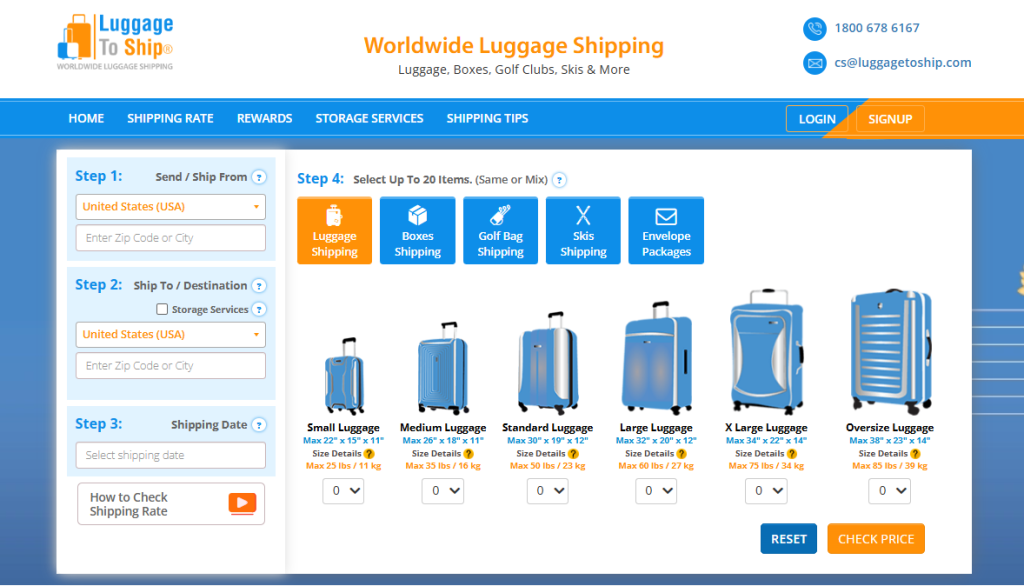
Step 1: Book Online or Call Us
Go to luggagetoship.com, enter your pickup address, destination country, and the details of each box — approximate weight and dimensions. The quote appears on screen instantly. For international routes, calling is worth it: an agent will walk you through destination-specific customs requirements before you book.
Step 2: Receive Your Shipping Labels
Your labels and shipping documents arrive by email (or mail if you prefer). Print one label per box, tape it flat to the top, and cover it with clear packing tape so it can’t peel. The routing and customs declaration are already on the label — no separate forms to hunt down.
Step 3: Pickup or Drop-Off
On your scheduled date, a FedEx or DHL driver collects every box from your home, office, or dorm. If a pickup window doesn’t fit your schedule, drop the labeled boxes at any of 25,000+ FedEx and DHL locations worldwide whenever it suits you.
Step 4: Delivered at Your New Address
Your boxes travel through the FedEx, DHL, or UPS network with tracking updates by email and SMS, clear customs as personal effects, and deliver door-to-door to your new home — or hold at a nearby location if you’d rather collect them.
How to Pack a Box for an International Journey
A box shipped overseas is lifted, scanned, loaded, and unloaded many more times than a domestic parcel. Pack for that reality.
| Rule | Why It Matters |
|---|---|
| New, double-walled cardboard only | Used boxes lose up to half their crush strength; single-wall boxes collapse under stacking |
| Keep each box under 50 lb (23 kg) | Safer handling, fewer surcharges, and within most carriers’ standard limits |
| Fill every gap | Clothing, packing paper, or bubble wrap — contents must not shift when the box is shaken |
| H-tape every seam | Tape along the center seam and both edge seams, top and bottom. Never masking tape |
| Wrap fragile items individually | Then cushion them in the center of the box, never against a wall |
| Photograph the packed contents | Before sealing — the single most useful thing you can do for any insurance claim |
| Label twice | The shipping label on top, plus your name, destination address, and phone written on a side panel |
One more that saves money: consolidate. Two half-full boxes cost more to ship than one full one. Pack tight, pack fewer.
Customs for Personal Belongings: What Actually Happens
This is where people get anxious, and mostly needlessly. Used personal belongings shipped for your own use are treated as personal effects by nearly every customs authority, and in most countries they enter free of import duty — provided you declare them accurately.
The universal rules:
- Declare everything honestly, using realistic used values rather than replacement cost
- Ship used items, not new ones — brand-new goods in original packaging can attract duty
- Keep a simple inventory — a one-page list per box is usually enough
- Avoid restricted items — aerosols, loose lithium batteries, liquids over carrier limits, food, plants, and anything the destination prohibits
- Expect occasional inspection — routine, and rarely adds more than a day or two
Rules vary by country, so check the destination’s own guidance. For boxes leaving the US, U.S. Customs and Border Protection publishes export rules. For the UK, HMRC’s Transfer of Residence relief can remove import duty and VAT on used belongings when you’re making the UK your home — apply before the boxes arrive. For the EU, the European Commission’s customs portal explains personal-property relief for people transferring residence. LuggageToShip generates the customs paperwork with your labels, and the 24/7 support team can confirm destination-specific requirements before you book.
Shipping Boxes to Europe: A Closer Look
Europe is the single most common destination for Americans shipping boxes overseas — students, remote workers, retirees, and people following a partner or a job. A few things to know:
- Transit time: 5–10 business days standard from the US to most of Western Europe; 2–4 days express
- Customs relief: Most EU countries and the UK offer duty relief on used personal belongings for people transferring residence. The UK requires a ToR1 application before arrival; EU countries generally handle it at import with proof of your move
- Two-tier reality: The UK is no longer in the EU customs union, so a box to London and a box to Paris follow different paperwork — our labels handle both, but declare accurately for each
- Winter timing: If you’re arriving in autumn, ship your winter clothes in the first batch — European winters start earlier than most Americans expect
- Power and appliances: Europe runs on 230V. Leave US appliances behind rather than shipping dead weight; buy locally or use adapters only for electronics with dual-voltage chargers
For a step-by-step on the belongings side of a move — what to carry, what to ship, what to leave — see our guide on how to ship personal items overseas.
What Drives the Cost to Ship Boxes Overseas
Anyone quoting a single number without seeing your route is guessing. International box shipping cost is driven by five factors:
| Factor | Effect on Price |
|---|---|
| Weight | The largest driver — a 20 lb box costs meaningfully less than a 50 lb one |
| Dimensions | Oversized boxes trigger dimensional-weight pricing; standard moving-box sizes avoid it |
| Destination | Western Europe, Canada, and major Asian hubs are cheapest; remote destinations cost more |
| Speed | Standard service costs far less than express |
| Number of boxes | Per-box pricing — which is exactly why consolidating into fewer, fuller boxes saves money |
What matters more than the figure is the comparison. A freight share charges you for space whether you fill it or not. Retail carrier counters charge walk-in rates with pickup, insurance, and support as extras. A courier service like LuggageToShip books the same FedEx, DHL, and UPS networks at discounted commercial rates — up to 70% below retail — and includes doorstep pickup, labels, customs documents, insurance, and tracking in the price. The only way to know your number is an instant quote for your exact route.
Why LuggageToShip for International Box Shipping
- Partners with FedEx, DHL, and UPS — three of the world’s largest logistics networks
- Ships to 220+ countries and territories
- Savings of up to 70% off retail carrier rates
- Door-to-door service — pickup at your old address, delivery at your new one
- Default insurance included on every box, with optional higher coverage
- Six months of free storage — ship boxes before you’ve signed a lease and forward them when you have an address
- 24/7 human support, including customs guidance
- Mixed shipments welcome — send boxes, suitcases, and a bike in one booking
That storage point deserves emphasis for international movers: the gap between leaving one home and getting keys to the next is the most stressful part of any overseas move. Ship your boxes into free storage now, and forward them the day your new address is confirmed.
For a comparison of providers, see our ranking of the best box shipping services and the best international luggage shipping companies.
Timing Your Shipment
- Standard international: Ship 7–10 days before you need the boxes
- Express: 2–4 business days on most major routes
- Peak seasons: Add 2–3 buffer days in late August (student moves), December, and around major holidays
- No address yet? Ship into free storage and forward once you’ve signed
Conclusion
Learning how to ship boxes overseas turns out to be far simpler than the freight-forwarding internet suggests — as long as you match the method to your volume. For a furnished house, hire a container company. For the boxes that make up almost every real-world international move, door-to-door courier shipping gets them there in days, at a fraction of freight cost, with the paperwork handled for you.
LuggageToShip collects at your door, ships through FedEx, DHL, and UPS to 220+ countries, includes insurance and tracking, and stores anything you’re not ready to send for six months free. Get an instant quote, tape up your boxes, and let them meet you at your new front door.
Frequently Asked Questions
What is the cheapest way to ship boxes overseas?
For 1–12 boxes, per-box door-to-door courier shipping is cheapest — you pay only for what you send, not for container space. LuggageToShip books FedEx, DHL, and UPS at up to 70% off retail rates.
Can I ship boxes overseas without a freight company?
Yes. A courier service handles pickup, customs paperwork, tracking, and delivery for standard boxes — no freight company, container, or shipping agent required.
How long does it take to ship boxes internationally?
Standard courier service takes 5–10 business days on most routes; express arrives in 2–4 days. Freight shipping, by comparison, takes 4–12 weeks.
Do I pay customs duty on boxes of personal belongings?
Usually not. Most countries admit used personal effects duty-free when declared accurately with realistic used values. Brand-new items in original packaging may attract duty.
How does LuggageToShip ship boxes overseas?
Book online or by phone, receive labels by email, schedule a doorstep pickup or drop off at any FedEx or DHL location, and your boxes are delivered door-to-door with customs paperwork generated at booking.
What carriers does LuggageToShip partner with?
LuggageToShip partners with FedEx, DHL, and UPS — the three largest global logistics networks — for delivery to 220+ countries.
How do I ship boxes to Europe from the USA?
Pack in new double-walled boxes under 50 lb, book a courier shipment, and declare contents as used personal effects. Standard transit is 5–10 business days; the UK requires a ToR1 relief application before arrival, while most EU countries handle relief at import.
What size box is best for international shipping?
Standard medium moving boxes (around 18 × 18 × 16 inches) are ideal — large enough to be efficient, small enough to stay under 50 lb and avoid dimensional-weight pricing.
Can I send boxes abroad before I have a new address?
Yes. LuggageToShip includes six months of free storage — ship your boxes now and forward them once your new address is confirmed.
What can’t I put in a box shipped overseas?
Aerosols, loose lithium batteries, liquids over carrier limits, perishable food, plants, and anything prohibited by the destination country. Keep passports, medications, and valuables with you.
Are shipped boxes insured?
Yes. Default insurance is included on every LuggageToShip box, with optional higher coverage for valuable contents.
Can I track my boxes in transit?
Yes. Every shipment includes real-time tracking by email, SMS, and online dashboard, using the carrier’s own tracking number.
Is it cheaper to ship one big box or several small ones?
One full box is almost always cheaper than two half-full ones, because pricing is per box. Consolidate tightly, but keep each box under 50 lb.
Can I ship boxes and a suitcase together?
Yes. LuggageToShip handles boxes, suitcases, bikes, skis, and golf bags in a single booking with the same pickup and door-to-door delivery.
