
TL;DR
You don’t need a moving company or a shipping container to ship personal items overseas — for anything under about ten boxes or bags, a door-to-door courier service is faster, cheaper, and far simpler. LuggageToShip picks up from your home, ships through FedEx, DHL, and UPS to 220+ countries, and includes six months of free storage.
Introduction
Search for how to ship personal items overseas and you’ll land in a world you probably don’t belong in: ocean containers, less-than-container-load freight, ratchet straps, marine cargo insurance, and quotes that start at several thousand dollars. That advice is written for people relocating an entire furnished house across an ocean. It is almost useless for everyone else.
And everyone else is most people. The graduate moving to London for a first job. The retiree spending six months in Portugal. The student heading to a semester in Sydney.
The family sending a grandmother’s belongings to a daughter in Toronto. These moves involve a few suitcases, a handful of boxes, maybe a bike — not a container. They need a completely different playbook, and this is it.
This guide covers the simple, courier-based way to ship personal belongings overseas: when it makes sense, how it works in four steps, what to pack and what to leave, how customs actually works for personal effects, and the two most common routes — US to Canada and US to the UK — in detail.
Container or Courier? Pick the Right Method First
Before anything else, be honest about your volume. This single decision determines everything.
| Factor | Container / Freight Shipping | Door-to-Door Courier (LuggageToShip) |
|---|---|---|
| Best for | Full households, furniture, 10+ large boxes | Suitcases, boxes, bags, bikes, sports gear — under ~10 pieces |
| Transit time | 4–12 weeks by sea | 3–10 business days |
| Pickup | Often depot drop-off or scheduled crew | Doorstep pickup from home, office, or hotel |
| Delivery | Port or depot; final-mile often extra | Door-to-door to your new address |
| Paperwork | Extensive — packing lists, port forms, agents | Labels and customs forms generated for you |
| Tracking | Limited | Real-time via FedEx, DHL, or UPS |
| Storage | Rented separately | 6 months free with LuggageToShip |
| Typical cost | Thousands of dollars | Priced per piece — quote instantly |
If you’re moving a furnished home, a container company is the right call and we’ll happily say so. If you’re moving your life in bags and boxes — which describes the vast majority of overseas moves — keep reading.
How to Ship Personal Items Overseas in 4 Steps
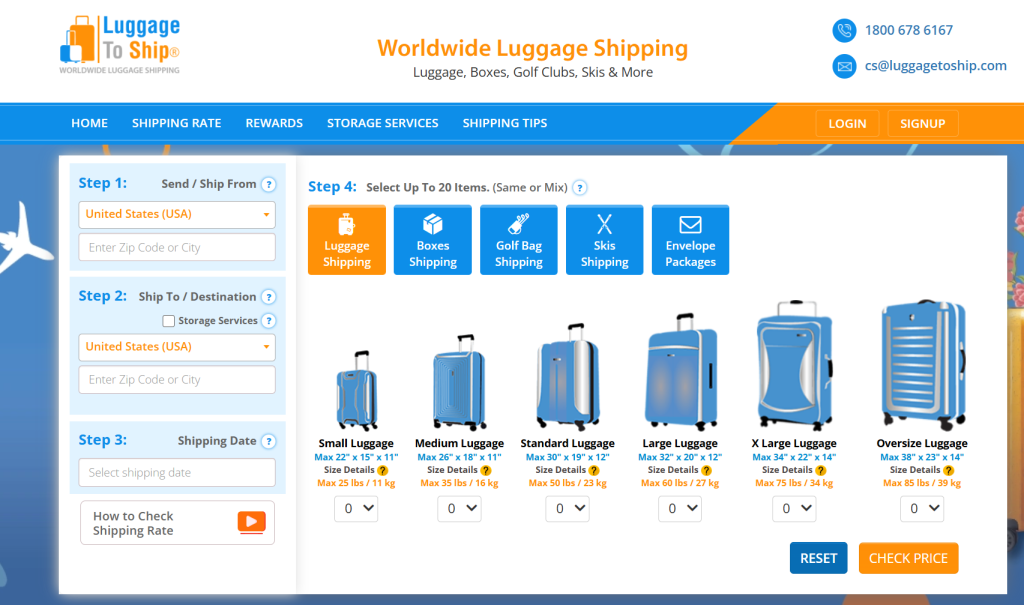
Here’s the entire process from your living room to your new front door.
Step 1: Book Online or Call Us
Go to luggagetoship.com, enter your pickup address, destination country, and the details of each piece — a suitcase, a box, a bike, a golf bag — with approximate weight and dimensions. The quote appears on screen instantly. Prefer to talk it through? Call, and an agent will handle the whole booking by phone, including advice on destination-specific customs requirements.
Step 2: Receive Your Shipping Labels
Your shipping documents and labels arrive by email (or mail if you prefer). Print them and attach one securely to each bag or box. The label already carries your routing and customs information — there are no separate port forms, no agent to appoint, nothing else to complete.
Step 3: We Pick Up or You Drop Off
On your chosen date, a FedEx or DHL driver collects every piece from your door — home, office, dorm, or hotel. If a pickup window doesn’t suit your schedule, drop your labeled items at any of 25,000+ FedEx and DHL locations worldwide whenever it’s convenient.
Step 4: Delivered at Your Destination
Your belongings travel through the FedEx, DHL, or UPS network with tracking updates by email and SMS at every stage, clear customs as personal effects, and arrive door-to-door at your new address — or hold for pickup at a nearby location if you’d rather collect them yourself.
What to Ship, What to Carry, What to Leave Behind
The most experienced overseas movers all say the same thing in hindsight: they shipped too much. Use this framework before you pack a single box.
| Category | Decision | Examples |
|---|---|---|
| Carry with you | Irreplaceable, needed on day one | Passport, visa, medications, laptop, jewelry, cash, chargers |
| Ship ahead | Bulky, heavy, or exceeds airline limits | Off-season clothing, books, bedding, kitchenware, sports gear, bikes |
| Buy on arrival | Cheap and universally available | Toiletries, hangers, cleaning supplies, basic groceries |
| Store at home | Uncertain, seasonal, or sentimental | Winter coats for a summer posting, furniture, keepsakes |
| Sell or donate | Replaceable and not worth the shipping cost | Old electronics, worn furniture, duplicate kitchen items |
The “store at home” row is where LuggageToShip changes the equation: items you can’t decide about can ship into six months of free storage and be forwarded to you later if you end up needing them — or shipped back home if you don’t.
How to Pack Boxes and Bags for an International Move
Packing for a courier journey is different from packing for a container. Each piece is handled individually, multiple times, across multiple vehicles. Pack accordingly:
- Boxes: New, double-walled cardboard only. Fill every gap with paper or clothing so nothing shifts. Tape all seams using the H-method. Keep each box under 50 lbs (23 kg).
- Suitcases: Hard-shell if possible. Lock the zips with a cable tie, not a padlock (customs may need to open it). Wrap in a suitcase cover or stretch film for scuff protection.
- Soft bags and duffels: Fine for clothing and linens only — never for fragile or valuable items.
- Bikes and sports gear: Padded bag or hard case; remove pedals, turn the bars, deflate tires slightly.
- Everything: Photograph the contents of each piece before sealing. Label the outside with the destination address and your phone number in addition to the shipping label.
Customs for Personal Effects: What Actually Happens
This is where most people get anxious — unnecessarily. Used personal belongings shipped for your own use are treated as personal effects by nearly every customs authority in the world, and in most countries they enter duty-free, provided you declare them accurately.
A few universal rules:
- Declare everything honestly with realistic used values — not replacement values.
- Ship used items, not new ones. Brand-new goods in original packaging can attract import duty.
- Keep a simple inventory — a one-page list per box is usually enough.
- Avoid restricted items: aerosols, loose lithium batteries, liquids over limits, food, plants, and anything the destination country prohibits.
- Expect occasional inspections. They’re routine and rarely add more than a day or two.
LuggageToShip generates the customs documentation with your labels and the 24/7 support team can walk you through destination-specific requirements before you book. For official US export guidance, U.S. Customs and Border Protection publishes current rules.
Two Routes Worth a Closer Look
Shipping Personal Belongings From the US to Canada
The most common cross-border personal move in North America, and one of the simplest — with one rule that catches people out. If you’re settling in Canada or returning as a former resident, the Canada Border Services Agency lets you import your owned, used personal effects duty- and tax-free, but you must declare them on arrival at your first point of entry — even if the goods haven’t physically arrived yet.
The officer records your list on Form BSF186 (the Personal Effects Accounting Document), split into goods accompanying you and “goods to follow.” Anything shipped later that wasn’t on that original list can lose its duty-free eligibility, so list everything before you land. Full details are on the official CBSA “Moving or returning to Canada” page.
Transit by courier runs 3–7 business days door-to-door — versus weeks by freight. Note that food, plants, and certain wood items face strict biosecurity checks.
Sending Personal Belongings to the UK
Transatlantic moves are LuggageToShip’s bread and butter. If you’re making the UK your main home, HMRC’s Transfer of Residence (ToR) relief lets you bring in used personal belongings free of import duty and VAT — but you apply before your goods arrive using the ToR1 form, and the relief covers items you’ve owned and used, not new purchases still in their packaging. Students moving for full-time study are also eligible. The official guidance and application are on GOV.UK: Transfer of residence to the UK and Moving personal belongings to the UK.
Transit by courier is typically 5–10 business days. Ship winter clothing ahead in autumn; you’ll need it sooner than you think.
Why Courier Shipping Beats Everything Else for Small Moves
The overseas shipping cost conversation usually starts with “how much does a container cost?” — the wrong question for most people. When you’re moving a handful of pieces, the cheapest way to ship overseas is almost always per-piece door-to-door courier shipping, because you pay only for what you send, not for the empty space in a container.
LuggageToShip makes that model as simple as it gets:
- Partners with FedEx, DHL, and UPS — three of the world’s largest logistics networks
- Ships to 220+ countries and territories
- Savings of up to 70% off retail carrier rates
- Door-to-door international shipping — pickup at your old address, delivery at your new one
- Default insurance included on every piece, with optional higher coverage
- Six months of free storage on every shipment, then $10 per item per month
- 24/7 human customer support, including customs guidance
For related reading, see our guides on how to ship boxes and the best international luggage shipping companies.
Timing Your Overseas Shipment
- Standard international: Ship 7–10 days before you need your items
- Express international: 2–4 business days on most major routes
- Peak seasons: Add 2–3 buffer days around late August (student moves), December, and major holidays
- Unsure of your new address yet? Ship into free storage now and forward once you’ve signed a lease
Conclusion
Learning how to ship personal items overseas turns out to be far simpler than the freight-forwarding internet makes it sound — as long as you’re honest about your volume. For a furnished house, hire a container company. For the suitcases, boxes, bikes, and bags that make up almost every real-world overseas move, a door-to-door courier service does the job in days, not weeks, at a fraction of the cost, with none of the paperwork.
LuggageToShip picks up at your door, ships through FedEx, DHL, and UPS to 220+ countries, includes insurance and tracking, and stores anything you’re not ready to send for six months free. Get an instant quote, tape up your boxes, and let your belongings meet you at your new front door.
Frequently Asked Questions
What is the cheapest way to ship personal items overseas?
For anything under roughly ten boxes or bags, per-piece door-to-door courier shipping is the cheapest option — you pay only for what you send. LuggageToShip offers savings of up to 70% off retail FedEx, DHL, and UPS rates.
Can I ship personal belongings overseas without a moving company?
Yes. A door-to-door courier service like LuggageToShip handles pickup, customs paperwork, tracking, and delivery for boxes, suitcases, and bags — no moving company or container required.
How long does it take to ship personal items internationally?
Standard courier service takes 5–10 business days on most routes; express options arrive in 2–4 days. Container shipping, by contrast, takes 4–12 weeks.
Do I pay customs duty on used personal belongings?
Usually not. Most countries treat used personal effects shipped for your own use as duty-free when declared accurately with realistic used values. Brand-new goods may attract duty.
How does LuggageToShip work for overseas moves?
Book online or by phone, receive shipping labels by email, schedule a doorstep pickup or drop off at any FedEx or DHL location, and your belongings are delivered door-to-door at your destination.
What carriers does LuggageToShip partner with?
LuggageToShip partners with FedEx, DHL, and UPS — the three largest global logistics networks — with delivery to 220+ countries.
Can I ship a suitcase internationally instead of checking it?
Yes. Shipping a suitcase door-to-door avoids airline overweight and excess-bag fees, and it arrives at your destination before you do.
How do I ship personal belongings from the US to Canada?
Book a courier shipment and declare your used items to CBSA at your first point of entry — listing any “goods to follow” on Form BSF186 so later shipments keep their duty-free status. Expect 3–7 business days door-to-door.
How do I send personal belongings to the UK?
Apply for HMRC’s Transfer of Residence (ToR1) relief before your goods arrive if you’re making the UK your main home — it removes import duty and VAT on used belongings. Ship by courier with an accurate inventory; transit is typically 5–10 business days.
Can I ship personal items across the country domestically?
Yes. LuggageToShip ships across all 50 US states with the same doorstep pickup and door-to-door delivery — ideal for cross-country moves without a rental truck.
What items can’t be shipped overseas as personal effects?
Aerosols, loose lithium batteries, liquids over carrier limits, perishable food, plants, and any item prohibited by the destination country. Check restrictions before packing.
Is my shipment insured?
Yes. Default insurance is included on every LuggageToShip piece, with optional higher coverage available for valuable items.
What if I don’t have my new overseas address yet?
Ship into LuggageToShip’s six months of free storage now and forward your items once you’ve secured accommodation.
Can I track my belongings while they’re in transit?
Yes. Every shipment includes real-time tracking by email, SMS, and online dashboard from pickup to delivery.
